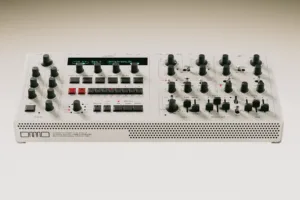
Behringer JAM and JAM PLAY: two 32-key sequencer keyboards with CV outputs
Behringer unveils the JAM, a 32-key controller and sequencer with CV/Gate outputs, and the JAM PLAY, the same base with 128 built-in sounds. Price not announced.

Behringer has put up product pages for two compact keyboards built on the same foundation: the JAM, a MIDI controller and sequencer with no sounds, and the JAM PLAY, which adds a display and a built-in sound bank. Both models leaked in the spring; they are now official.
Who they are for
The JAM is aimed at musicians who want a backpack-sized keyboard that can play more than a computer. Its CV (control voltage, which sets a note’s pitch), Gate (the pulse that triggers the note) and Mod outputs connect straight to an analog synth or a modular system, with no interface in between. It is a sensible first controller for anyone starting out with a CV-equipped monosynth or a small Eurorack case.
The JAM PLAY is more for writing on the move without a computer: Behringer pitches it as a self-contained songwriting station, with 128 instrument voices, 10 drum kits and effects. It is not a synthesizer in the sense this site uses the word: it is a general-purpose sound bank, handy for sketching a track, not for designing a sound.
What they cost
Price not announced by Behringer on its product pages at the time of writing, and no availability date either. We will update this article when the manufacturer publishes an official price.
What is inside
Sequencer and arpeggiator
The heart shared by both models is a 64-step polyphonic sequencer: each step holds up to 8 notes, with rest, tie and legato entry. Ratchet (fast repeats of a single step) and random gate functions add variation without rewriting the sequence. The arpeggiator offers 8 styles and up to 8 simultaneous notes per step; Chord Play fires chords of up to 16 notes from a single key. The JAM PLAY spreads its sequencer across 4 channels.
Specifications
| Item | JAM | JAM PLAY |
|---|---|---|
| Keys | 32 compact keys, velocity and aftertouch sensitive | |
| Controls | 4 assignable controls, pitch and modulation touch strips, Record, Play, Stop | |
| Sequencer | 64 steps, 8-note polyphony | 4 channels, 64 steps, 8-note polyphony |
| Built-in sounds | none | 128 voices, 10 drum kits, effects |
| Display | no | multi-function OLED |
| Connections | class-compliant USB, MIDI Out, CV/Gate, Sync, sustain pedal input | class-compliant USB, MIDI Out, CV/Gate, Sync |
| Power | USB or optional DC adapter | USB |
Four sync sources can be selected from the front panel, so the JAM can lock to a DAW, a drum machine or a modular clock. For a Eurorack rack that needs far more voltages than a single keyboard provides, a dedicated converter such as the Squarp Core plays in another league.
What they compete with
- Arturia KeyStep: the benchmark the JAM openly targets. Same 32-key format with velocity and aftertouch, same touch strips, a 64-step polyphonic sequencer and CV/Gate/Mod outputs. The JAM adds four assignable encoders, ratchet and a 16-note chord mode. View at Thomann
- Akai MPK Mini Play: for the JAM PLAY, the natural rival is this small keyboard with built-in sounds and a speaker, but without CV outputs or a comparable polyphonic sequencer.
On paper, the JAM takes the KeyStep recipe and adds to it; the verdict will come down to the price, which Behringer has yet to publish, and to the feel of the keys, which can only be judged in person. More new gear in our Announcements section.
Sources: Behringer product pages for the JAM and the JAM PLAY.