
OXI Coral 3.0: six new engines and build-your-own firmware
Firmware 3.0 for Coral, OXI Instruments’ polyphonic Eurorack voice, adds six engines (27 in total) and lets you choose the ten you load into the module.
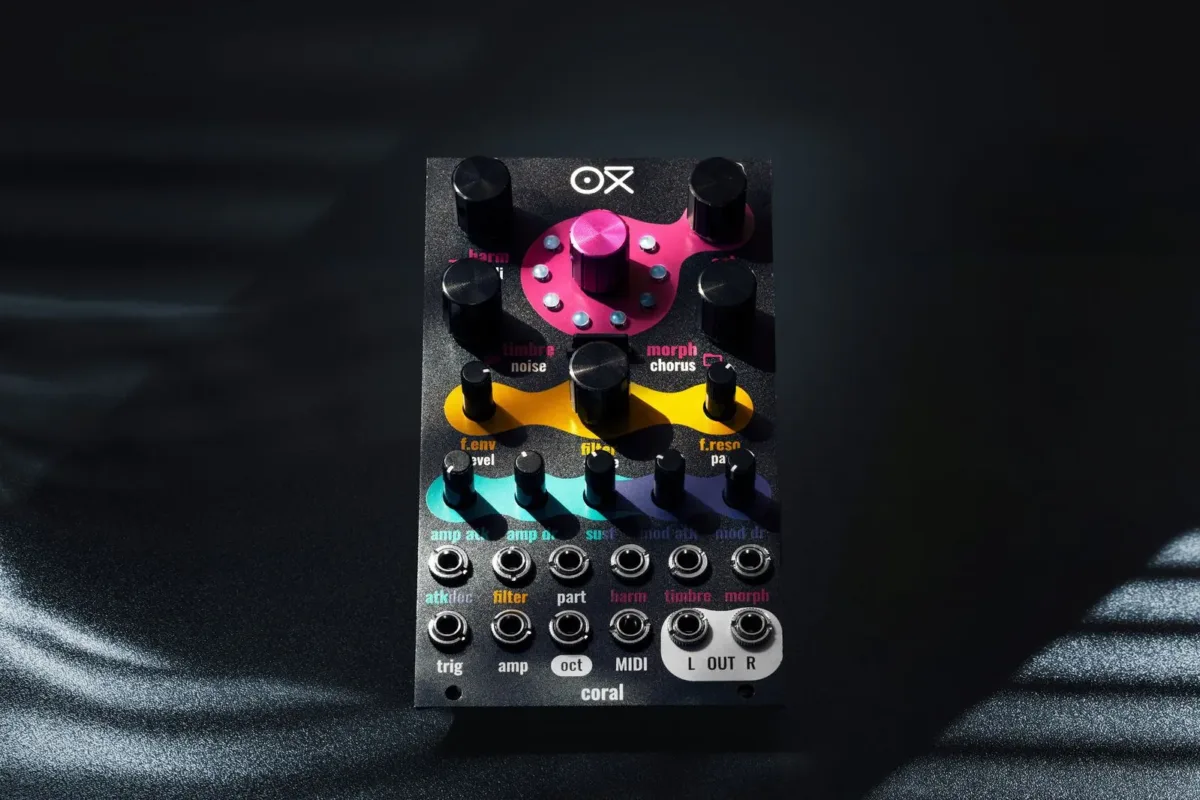
OXI Instruments, the maker of the OXI One sequencer, released firmware 3.0 for Coral in early October. Coral is its eight-voice polyphonic synth voice in Eurorack format. The update adds six synthesis engines, bringing the total to 27, and changes how you install them: you now build your own firmware by choosing up to ten engines, as described on the Coral product page.
What Coral 3.0 changes
Six new engines
- FMX7: an FM engine modelled on the Yamaha DX7, the reference for 1980s FM synthesis. Synth Anatomy, which reported the update, adds that it loads DX7 patches from the microSD card.
- OB-VA: an Oberheim-inspired virtual analog engine.
- ACID 2: the next version of the TB-303-style bass engine introduced with firmware 2.0.
- String 2: a second string ensemble engine.
- PianoZ: ready-to-play piano, electric piano and organ.
- Stitcher: an experimental engine built for drones.
Build-your-own firmware
Coral cannot hold all 27 engines at once. OXI’s browser-based Firmware Updater installs the update and builds a custom firmware with the ten engines you pick. That means making choices: a rhythm-focused rack will keep the drum engines (kick, snare, hi-hat), while a pad-focused one will favour strings, wavetable and the new Stitcher.
Drone mode and Engine Memory
Version 3.0 also adds a Drone mode, which holds the sound without a note trigger, an Engine Memory feature and, in OXI’s words, “a lot of quality of life improvements”, which the product page does not list in detail.
Who it is for
A modular system plays one note at a time by default: each oscillator is one voice. Getting chords means stacking complete voices, as our article on polyphony, paraphony and voice count explains. Coral 3.0 is aimed at:
- existing Coral owners, who get six engines without new hardware;
- modular players who want chords and pads in 14 HP, with eight full voices and up to eight oscillators per voice (64 in total);
- anyone driving their rack over MIDI: every parameter responds to MIDI CC, and the module supports MPE, a standard that sends expression (pressure, slides) per note from a compatible controller.
To check space and power before adding a module this size, our guide Eurorack explained: choosing your first case is the place to start.
What it costs
| Item | Price | Availability |
|---|---|---|
| Firmware 3.0 | free for owners | available through the Firmware Updater |
| Coral module (14 HP) | €395 | on sale in the OXI web shop, standard or Black Edition |
Price as listed in the OXI Instruments web shop at the time of writing. View at Thomann
What it competes with
| Module | Width | Polyphony | Strength |
|---|---|---|---|
| OXI Coral | 14 HP | 8 voices | 27 engines, multitimbral, MPE, built-in effects |
| Hampshire Electronics Janus | 10 HP | 2 engines of 8 voices | chords and arpeggios in a narrow module |
| Hampshire Electronics Apollo | 19 HP | 2 engines of 8 voices | MIDI and eight multitimbral layers |
| Mutable Instruments Plaits | 12 HP | monophonic | the multi-engine reference, no longer made |
The most direct rival has just arrived: Hampshire Electronics’ Janus and Apollo also bet on digital multi-engine polyphony, with two simultaneous engines and a chord engine. Coral keeps the edge on engine count (27 against 12) and deep MIDI integration; Janus and Apollo answer with two layerable engines and a polyphonic arpeggiator. OXI openly credits Mutable Instruments’ Plaits, a monophonic voice whose approach Coral multiplies by eight.
The trade-off of build-your-own firmware is plain: ten engines at a time, not twenty-seven. Changing the selection means another trip through the Firmware Updater, which is not something you do mid-gig.
Hear the engines
OXI has published a no-talk tour of every engine:
Sources: Coral product page at OXI Instruments; Synth Anatomy for the FMX7 detail. More firmware news lives in our Firmware Updates section.
