
UDO DMNO ON brings the 8-voice DMNO to an expandable desktop
UDO Audio turns its DMNO into a desktop unit: the same 8 hybrid voices, two multitimbral parts and a control surface that grows with add-on modules.
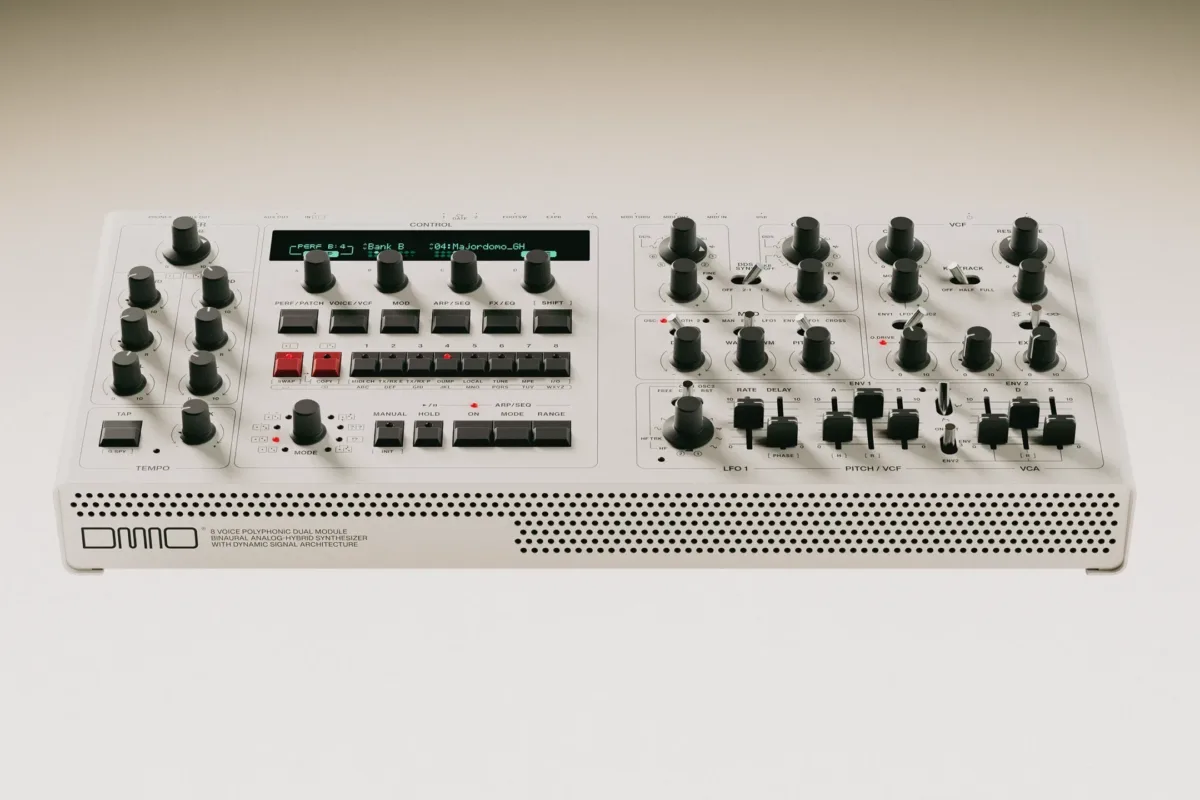
UDO Audio has taken its DMNO hybrid synthesizer out of its keyboard. The DMNO ON keeps the whole engine, 8 voices and two multitimbral parts, in a 487 mm wide desktop case. The real novelty is the “ON” approach: a base control surface that you extend by bolting control modules alongside it.
Who it is for
The DMNO ON targets players who already own a master keyboard, or whose studio is short on space, and want a high-end polysynth without another keybed. It also suits anyone driving sounds from an external sequencer: the desktop unit is VESA compatible according to UDO, so it can sit on an arm or a monitor stand.
Buying happens in two steps. The base unit gives you one set of controls; the ONM-1 expander adds the second panel and recreates the dual-panel layout of the keyboard DMNO. If you mostly tweak one sound at a time, you can skip it; if you play both parts live, you will want it.
Price
- DMNO ON: no list price published by UDO Audio on its product page at the time of writing.
- ONM-1 Synth Control (second synth panel): listed as “available at launch”, price not disclosed by the manufacturer.
- ONM-2 FX Control (effects and EQ controls): listed as “coming soon”.
UDO points buyers to its dealer network and gives no official shipping date. We will update this article once the manufacturer publishes pricing.
What is inside
The DMNO is built on two complete synths, DMNO 1 and DMNO 2, each with its own oscillators, filter, modulation and effects. It is multitimbral: the two parts can play two different sounds at once, layered, split across the keyboard or on separate MIDI channels.
Digital oscillators, analog filters
The oscillators are digital, generated by an FPGA (a programmable chip that runs the processing in hardware rather than software). Each oscillator pairs a centre oscillator with six “sister” oscillators that can be de-phased across the stereo field, which is where the supersaw-style thickness comes from. The signal then runs through two analog stereo filters that can be set in parallel, series or stereo, with low-pass, high-pass, band-pass, all-pass and phaser responses depending on the mode.
Binaural mode
A UDO trademark since the Super 6: in binaural mode each ear gets a complete synth voice, which can be detuned and de-phased against the other. Polyphony then drops to 4 “super” voices. For the difference between voices, polyphony and paraphony, browse the instruments in our Polyphonic synthesizers section.
Specifications
| Item | DMNO ON |
|---|---|
| Polyphony | 8 voices (4 in binaural mode), 2 parts |
| Play modes | Single, Dual, Split, One-Two, Rotate, Random, Chaos, Cascade |
| Envelopes and LFOs | 3 envelopes, 2 LFOs (LFO 1 from under 0.1 Hz to over 10 kHz) |
| Effects | 32-bit DSP: send delay and reverb, insert distortion, chorus and EQ |
| Sequencer | 64 steps, 16 memories; syncable arpeggiator |
| Memory | 256 performances, 256 patches |
| Connections | DIN MIDI in/out/thru, USB MIDI, 2-in/2-out 24-bit USB audio interface, stereo audio input, stereo aux output, 2 CV and gate/clock outputs on 3.5 mm jacks |
| Size and weight | 487 × 220 × 107 mm, 4.5 kg (ONM-1: 236 × 220 × 107 mm, 3 kg) |
The two CV/Gate outputs (a control voltage for pitch or modulation, plus a trigger pulse) let the DMNO ON sequencer drive an analog synth or a modular system. The external audio input has an envelope follower and a gate detector that feed the modulation matrix.
What it competes with
- UDO Super 6 Desktop: the in-house sibling, 12 binaural voices but only one sound at a time. The DMNO ON has fewer voices but two independent parts, more flexible stereo filters and CV outputs.
- Sequential OB-6 Desktop: 6 fully analog voices (oscillators included), an Oberheim SEM-inspired filter and a single part. Fewer voices and no multitimbrality, but an all-analog signal path.
The DMNO ON stands out for its mix of 8 voices, two parts and a built-in USB audio interface; judging value for money will have to wait for the official price.
Official demo
We have not heard it in person, so here is UDO Audio’s introduction video:
Source: DMNO ON product page, UDO Audio.
