
UDO DMNO ON
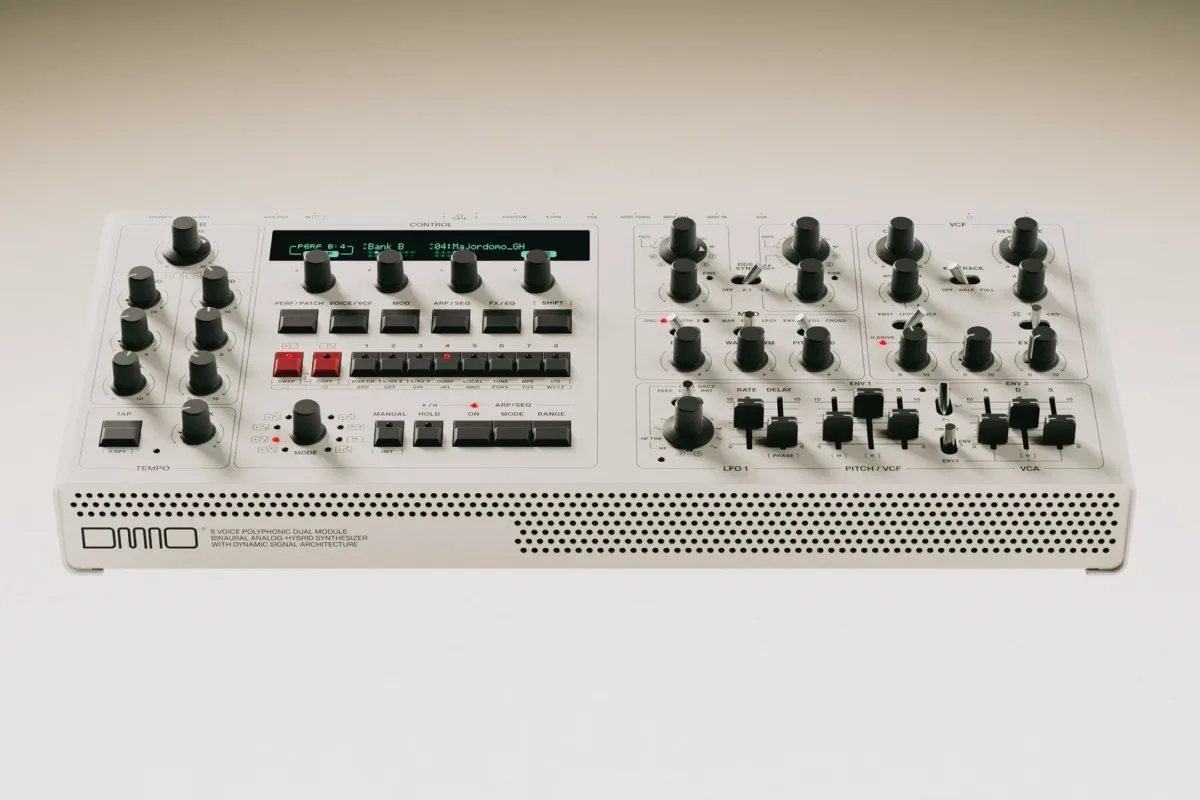
The desktop version of UDO Audio’s DMNO: the same 8-voice, bi-timbral hybrid engine, without a keyboard, expandable with control modules.

| Manufacturer | UDO Audio |
|---|---|
| Polyphony | 8 voices (4 in binaural mode), bi-timbral |
| Engine | Hybrid: FPGA digital oscillators (1 centre + 6 “sister” oscillators), per-voice analog stereo multimode filter |
| Launch price | Price not announced |
The DMNO ON is the desktop version of UDO Audio’s DMNO: the same 8-voice hybrid engine with two multitimbral parts, in a 487 mm wide case with no keyboard. Each of the two parts, DMNO 1 and DMNO 2, is a complete synth. Its oscillators are digital, generated by an FPGA (a programmable chip that processes sound in hardware rather than software): a centre oscillator plus six “sister” oscillators that can be spread across the stereo field. The signal then runs through an analog stereo filter, one per voice.
Highlights
- Two independent sounds and eight play modes that change how they share voices or feed each other.
- Binaural mode, a UDO trademark: each ear gets a complete voice, and polyphony drops to 4 “super” voices.
- A multimode filter (low-pass, high-pass, band-pass, all-pass, phaser) that can run in parallel, series or stereo, with overdrive.
- Three envelopes, two LFOs (the first runs from 0.1 Hz to over 10 kHz), a 64-step sequencer with 16 memories, an arpeggiator, 256 performances and 256 patches.
- 32-bit DSP effects: send delay and reverb, insert distortion and chorus, 3-band EQ.
- Full connectivity: DIN MIDI in/out/thru, a 2-in/2-out 24-bit USB audio interface, a stereo audio input with preamp, envelope follower and gate detector, a stereo aux output, and two CV and gate/clock outputs on 3.5 mm jacks to drive an analog synth or a modular system.
The ON system
The base unit carries a single set of controls but the whole engine. Two modules attach alongside it: the ONM-1 Synth Control, which recreates the dual-panel layout of the keyboard DMNO, and the ONM-2 FX Control, dedicated to the effects. The case is VESA compatible. Size: 487 × 220 × 107 mm and 4.5 kg for the base, 236 × 220 × 107 mm and 3 kg for a module.
Price not announced: UDO Audio lists neither a price nor an availability date on its product page. How it stacks up against the competition: our DMNO ON announcement story. Full specs on UDO Audio’s DMNO ON page.