Akai MPK Mini Plus II: 37 keys, MPC pads and three CV/Gate outputs
Akai updates its compact 37-key controller with a colour screen, pressure-sensitive pads and three CV/Gate outputs for modular rigs. Who it is for, what it costs, what it faces.
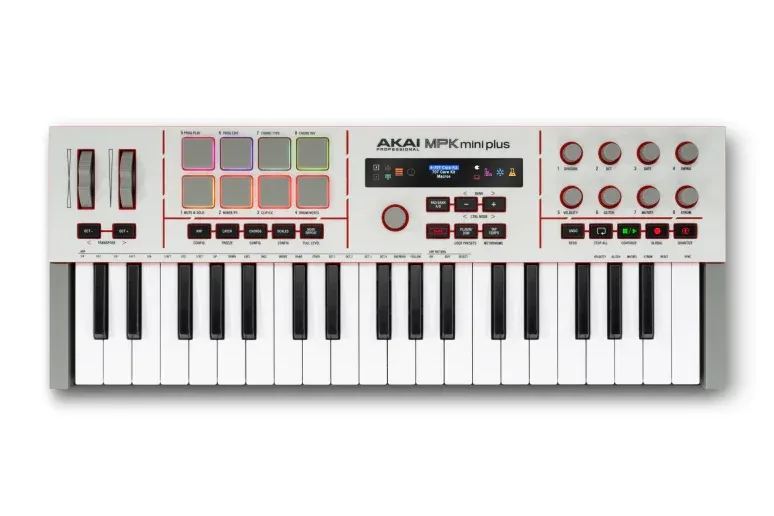
Akai Professional announced the MPK Mini Plus II on October 22, 2026, the second generation of its compact 37-key controller keyboard. It is available now at a list price of $169 (€159.99, £134.99), according to the manufacturer’s press release and the official product page. What sets it apart at this price: on top of USB and MIDI, it can drive a modular synth directly.
What the MPK Mini Plus II packs
Akai’s spec sheet lists:
- 37 mini keys on what Akai calls an upgraded keybed, with dedicated pitch and modulation wheels;
- 8 RGB-backlit MPC pads, velocity- and pressure-sensitive;
- 8 assignable endless (360°) knobs plus a push encoder;
- a 160 × 80 pixel colour display showing the parameters you are touching;
- performance tools: an expanded arpeggiator, chord mode, note repeat, and the Glitch, Mutate, Strum, Freeze and Follow functions.
Connections are the real selling point
The keyboard is powered over its USB-C port, which also carries MIDI to the computer. Around the back, a MIDI DIN output (the round 5-pin socket) drives a hardware synth without a computer, a jack takes a sustain pedal, and, most notably, there are three CV/Gate outputs on 3.5 mm minijacks. CV/Gate is the language of analog and modular synths: one voltage (CV) sets the pitch, another (Gate) says when a key is held down. Our guide Eurorack explained: the format and your first case shows how these signals move around a system.
The spec sheet lists only a MIDI DIN output: to receive MIDI from another device, you will have to go through USB.
On the software side
The MPK Mini Plus II comes pre-mapped for MPC 3, Ableton Live, Logic Pro, Cubase and FL Studio, and supports NKS, Native Instruments’ protocol for Komplete Kontrol. It controls both standalone MPCs and the MPC Desktop software: transport, pads, Q-Links, clip launching. MPC 3.10, which took MPC 3 Desktop out of beta, is covered in our article on the update. The bundle includes the Studio Instrument Collection (over 1,000 sounds from AIR Music Tech, Moog and Akai), Komplete Select Akai Edition, MPC Beats and Ableton Live Lite 12.
Who is it for?
For musicians who produce on a computer but also want to play their hardware: a first analog synth over MIDI, or a small Eurorack system over CV/Gate, without buying a separate MIDI-to-CV interface. The 37-key size and USB power also make it a good travel keyboard. If you are still deciding what to plug in behind it, our guide first synth: analog, digital or hybrid sets out the criteria.
How much?
$169 list price as announced by Akai (€159.99, £134.99), available now from dealers. View at Thomann
What does it compete with?
| Model | Keys | Pads | CV/Gate outs | MIDI DIN |
|---|---|---|---|---|
| Akai MPK Mini Plus II | 37 mini | 8 (velocity, pressure) | 3 | out |
| Arturia KeyStep 37 | 37 mini, with aftertouch | none | pitch, gate, mod | in and out |
| Arturia MiniLab 3 | 25 mini | 8 | none | none (USB only) |
- Arturia KeyStep 37: the obvious rival for modular users. Its keybed has aftertouch and it carries a polyphonic step sequencer, but it has no pads and no screen.
- Arturia MiniLab 3: smaller and built for the DAW, with neither CV nor MIDI DIN. It is out of the running as soon as hardware control matters.
The MPK Mini Plus II sits between the two: the connections of a modular-friendly keyboard with the workflow of a production controller, screen and pads included. More new hardware is in our announcements section.