Electra One mk3: the touchscreen MIDI controller goes 8-inch and adds Ethernet
Electra One opens pre-orders for the mk3, a touchscreen MIDI controller with an 8-inch display, a built-in MIDI router and Ethernet, at €599 excluding VAT.
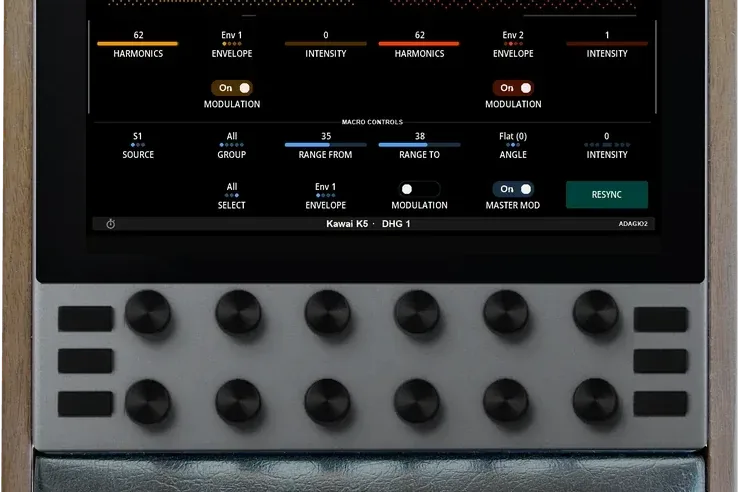
Czech maker Electra One has opened pre-orders for the Electra One mk3, the third generation of its touchscreen MIDI controller, the kind of device that edits a hardware synth’s parameters from a customisable graphical interface. The mk3 is listed at €599 excluding VAT on the manufacturer’s product page, with shipping promised before the end of February 2027. The announcement was picked up on 30 October by Synth Anatomy.
What changes from the mk2
The idea stays the same: each preset maps an instrument’s parameters (a Kawai K5 in the official picture) onto the screen and the encoders, so you never dig through the instrument’s menus. Everything else is new: enclosure, mainboard and I/O board. Electra One states that an existing mk2 cannot be upgraded to an mk3.
- 8-inch touchscreen at 1280 × 800 (7 inches on the mk2), with a 5 ms touch response. The mk2’s swipe navigation is gone in favour of direct page changes, on the same preset grid as the mk1 and mk2.
- Twelve high-resolution encoders, push-button and touch-sensitive, the same parts as on the Electra One Mini. A preset can respond to a turn or to a finger simply resting on a knob.
- Six assignable hardware buttons.
- Renesas RA8D2 processor, dual-core at 1 GHz, with one core reserved for MIDI messages, and 64 MB of unified RAM. The mk2 ran on a single-core 240 MHz chip.
- Hardware-accelerated, anti-aliased graphics at a higher frame rate.
A MIDI router as much as a control surface
The mk3 combines a USB-C device port (to the computer, which also powers it), a USB-C host port that handles up to eight USB devices, two pairs of 5-pin MIDI DIN sockets and an Ethernet port. The latter carries RTP MIDI (MIDI over a local network, supported natively by macOS and iOS), OSC (Open Sound Control, a network protocol with finer resolution than MIDI, used by many applications) and MIDI 2.0. The maker quotes a routing latency under one millisecond, set up on the screen or scripted in Lua, a lightweight scripting language.
If you mostly work over USB and DIN, this amounts to a multiport MIDI interface built into the controller, handy for linking several synths and a hardware sequencer without a computer.
| Item | Electra One mk3 |
|---|---|
| Controls | 12 push-button, touch-sensitive encoders, 6 buttons |
| Display | 8-inch touchscreen, 1280 × 800 |
| Connections | USB-C device, USB-C host (8 devices), 2 × MIDI DIN in and out, Ethernet |
| Network protocols | RTP MIDI, OSC, MIDI 2.0 |
| Presets | on the included SD card, 12+ running at once |
| Power | USB |
| Dimensions | 206 × 189 × 38 mm, VESA mount compatible |
The maker notes that the mk3 is still in development and that pictures will be updated. No official video is available yet.
Who it is for, what it costs, what it competes with
Who it is for. Owners of several hardware synths, often older ones with few front-panel controls, who want to edit them all from one surface and route their MIDI in the same place. Ethernet targets networked studios and stages where a computer drives the controller over OSC. A beginner whose first synth already has plenty of knobs has no use for it.
What it costs. €599 excluding VAT, paid in full at pre-order, for delivery before the end of February 2027. The controller ships with a USB-C cable and an SD card; the stand shown in the photos is not included.
What it competes with.
- The Electra One Mini, from the same maker, at €359 excluding VAT and in stock: the same preset platform in a 14 cm square, but with 8 encoders, a 5-inch non-touch screen, a USB host limited to two devices, minijack MIDI and no Ethernet, according to its product page.
- The Faderfox EC4, at €294 excluding VAT (€350 including VAT) according to the maker’s page: 16 encoders and a small four-line OLED display, minijack MIDI with merge, but no touchscreen and no USB host. Smaller and cheaper, it cannot display an instrument’s parameters the way the Electra does. View at Thomann
The mk3 stands out for its screen and for handling eight USB devices without a computer; in exchange it costs twice as much as an EC4 and will not ship for four months. mk2 owners get no upgrade path. It joins a busy autumn of controller and instrument announcements, from the Akai MPK Mini Plus II to the Squarp Core.