M-VAVE FM1 Open: official six-engine firmware and SDK released
DX7, 303, 808, chip, plucked strings and a sampler on eight tracks: M-VAVE releases free official firmware for the FM-1, with a web editor and SDK.

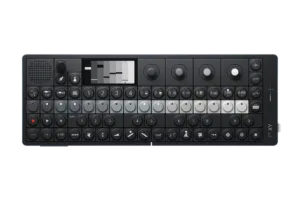
M-VAVE, the brand behind the FM-1, a small battery-powered FM synth inspired by the Yamaha DX7, has released FM1 Open: an official alternative firmware, its web editor and a development kit for writing your own firmware. Version V13 and its development kit went online on October 17, 2026 on the FM1 Workbench, the project’s official site. The manufacturer is responding to the wave of unofficial firmware that has appeared since the instrument launched.
Six engines instead of one
The stock FM-1 is an FM synth: a few sine oscillators, called operators, modulate each other’s frequency to build rich tones. The Open firmware keeps that engine and adds five more. Each track can use any of them, with its own settings:
- DX7: six-operator FM, with per-operator editing, algorithm selection and import of DX7 patches in .syx format.
- 303: a TB-303-style acid bass with cutoff, resonance, accent, slide and drive; playable monophonically with slide or with four-voice polyphony.
- 808: fully synthesized drums, eleven parts each adjustable on its own.
- PSG: 8-bit console and home computer chip sounds (YM, AY, noise and mixed modes).
- PLUCK: a plucked-string model with decay and brightness controls.
- SAMPLER: eight sample slots sharing about 20 seconds of memory. WAV files are imported from the browser.
A pocket groovebox
The firmware turns the FM-1 into a small all-in-one: eight tracks, each with its own 16, 32, 48 or 64-step loop, per-step parameter locks (a setting that applies to one step only), per-step probability, a per-track arpeggiator with swing and hold, a mixer with mute and solo, and sends to a shared reverb and delay. Every engine also gets an envelope and an LFO; for envelope basics, see our guide to the ADSR envelope.
MIDI essentials
| Item | FM1 Open V13 |
|---|---|
| Channels | Tracks 1 to 7 on channels 1 to 7, track 8 on channel 10 |
| MIDI inputs | Physical MIDI, USB and Bluetooth (BLE MIDI), same rules |
| Sync | MIDI clock at 24 pulses per quarter note, Start, Continue, Stop, Song Position, MMC |
| Not supported | RPN and NRPN, polyphonic aftertouch, MTC, Bank Select |
| Editing | Web editor in Chrome or Edge (Web MIDI), downloadable offline version |
Open, with conditions
What sets it apart from community hacks is the licence. The application is published under GPLv3 with an SDK linking exception: you may modify and redistribute it, but M-VAVE’s proprietary sound engine ships only as a binary inside the development kit. It is a managed opening, comparable to the OXI Coral 3.0 firmware, which also lets users build their own firmware, and more limited than the full code release of Mutable Instruments Beads.
Updating happens in the browser over a USB data cable. The official guide stresses backing up sounds, projects and samples first. As Synth Anatomy reported, M-VAVE warns that flashing may cause data loss or prevent the unit from starting.
Who is it for?
For FM-1 owners who want more than an FM synth: a small drum machine and a pocket acid bass, on batteries, controllable over Bluetooth. For developers, it is a cheap platform for writing their own engines. It is not the ideal tool to learn FM: detailed DX7 patch editing on such a small screen is hard work, and the web editor quickly becomes essential.
What does it cost?
The FM1 Open firmware, its editor and the development kit are free. M-VAVE does not state a recommended retail price for the FM-1 on the official pages we checked: price not disclosed.
What does it compete with?
- Korg NTS-1 digital kit mkII: another small programmable synth, open to third-party oscillators and effects through Korg’s logue SDK, but monophonic at heart and without a multitrack sequencer.
- Teenage Engineering Pocket Operators: the same pocket format and on-the-go use, but one fixed engine per model and no third-party firmware.
FM1 Open stands out for its six engines, eight tracks and open licence. It loses on the ergonomics of a tiny device and on the proprietary engine, which stays closed. For more recent updates, see our firmware updates section.