
Phaseburn One 1.0: a synth plugin built on a phase-locked loop
Phaseburn One reaches version 1.0 at €149: a synth plugin whose main voice is a phase-locked loop, with a probability sequencer that outputs MIDI and an effects rack with an audio input.
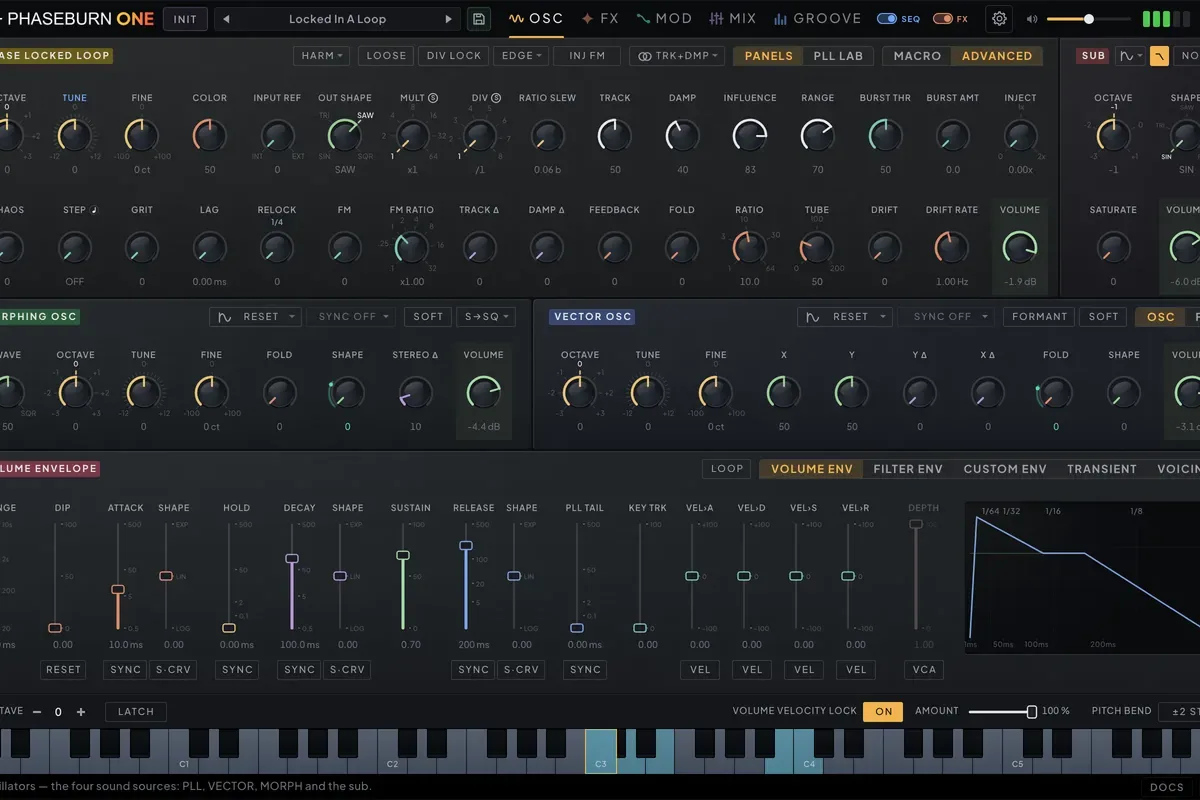
Phaseburn Music released Phaseburn One 1.0 on 15 October 2026, the small studio’s first synth, in public beta since late summer. It is the first full, paid release: according to the release notes, all 256 factory presets are finished, a new INIT patch is the starting point and a round of fixes covers transients, velocity and FM.
A voice built around a PLL
The instrument’s core is a phase-locked loop (PLL), a circuit borrowed from radio: an oscillator listens to a reference, measures how far its phase has drifted and keeps correcting itself. Phaseburn One makes it the main voice. Set tight, the loop locks and gives a stable pitch; set loose, the chase itself becomes audible: glides, overshoots, sirens and growls.
Three controls drive it: TRACK (how fast the oscillator chases), DAMP (how hard the correction brakes) and INFLUENCE (how strongly the reference pulls). Macros (GRIP, FIGHT, COLOR, WIDTH) open the loop by ear, a PLL LAB view charts it live, and the reference can come from another output of the synth or from external audio.
Four sources in one voice
- PLL: the main voice described above.
- VECTOR: a vector phase shaping oscillator, a method published in 2011 that bends a waveform’s phase around a movable point (X and Y coordinates), with its own FM section.
- MORPH: twelve waveform families, including seven detuned saws, additive up to 64 harmonics, vowel synthesis and a spectral wavetable.
- Sub: a sub oscillator from three octaves below the note to one above, which can bypass the effects to keep the low end clean.
All four share a single voice, but a paraphonic mode can give each its own note: a four-note chord running through the same filter and envelope. The difference from a true polysynth is covered in our guide to polyphonic, paraphonic and monophonic synths.
A sequencer that rolls dice
The Groove section works in probabilities rather than steps: 152 slots across one bar, spread over three simultaneous grids (straight, triplet, dotted), each with its own chance to fire. A “strength” map marks the beats that matter, and 127 rhythmic figures give starting points. Every generated note leaves the plugin as MIDI to the host, so it can drive other instruments.
An effects rack that also takes audio
Two filters (four-pole ladder and state-variable, with a MORPH between them), a frequency-shifting delay, a feedback-delay-network reverb, chorus, distortion, bitcrusher, a granular “freezer” and a master section with a limiter. Everything is patchable in a 64-bit patchbay, and an audio input lets you run a track from your project through the rack with no note held.
The official demo, where every sound comes from the instrument:
Who it is for, what it costs, what it competes with
Who it is for. Electronic producers after basses and textures a classic subtractive synth will not give, and grooves that change from bar to bar. Not for anyone wanting a known synth emulated: the developer states that Phaseburn One emulates no specific device.
What it costs. €149 including VAT, a perpetual DRM-free licence that activates offline on up to three machines, with 1.x updates included. VST3, CLAP and standalone on macOS and Windows, AU on macOS. A full free demo is available; it dips the volume periodically and blocks bouncing.
What it competes with. At this price, Phaseburn One sits among synth plugins with unusual engines rather than against all-rounders. It joins Imaginando’s additive COLAPSO, which builds sounds from the spectra of chemical elements, and AudioThing’s Materia, which resynthesises a sample. Its own edge: the probability sequencer that outputs MIDI and the audio-input rack, which make it an effect too. Its limits: a single voice, and an architecture you explore more than master straight away. One note from the developer before installing: 1.0 replaces the factory banks, so save any patches built on factory presets to a user bank first.


