Neuzeit Drop firmware 2.03 adds LFOs and motion recording
Free firmware 2.03 for the Neuzeit Drop adds Motion: LFOs, drawn waveforms and recorded gestures on up to 16 controls, stored per snapshot.

Neuzeit Instruments, the German maker of the Drop controller, released firmware 2.03 on November 10. The update is free and adds Motion, internal modulation: the Drop’s knobs and faders can now move on their own, driven by an LFO or by replaying a recorded gesture. This article is based on the official downloads page, which carries the release notes, and on the Drop product page.
What the Drop is
The Drop is a snapshot-based MIDI controller for live performance: a snapshot is a stored picture of every control position, recallable at any time. Its front panel lines up 32 detent-free encoders, 8 mutes and 8 faders, duplicated on two layers, and each control can send up to eight MIDI messages at once, each with its own curve. DROP mode, which gives the unit its name, fires a snapshot exactly at the end of a 1 to 32 bar cycle: pile on effects during the build, and the Drop puts everything back when the beat returns. The spec sheet lists:
- 2 USB-C MIDI ports, with automatic device or host detection;
- 4 MIDI inputs and 4 MIDI outputs on TRS type A or B jacks;
- 2 CV inputs and 2 CV outputs at 0-5 V, for clock or control voltages to a modular system (CV basics are covered in our Eurorack explainer);
- a master clock with a per-output delay adjustable to the millisecond;
- a 275 × 220 × 38 mm metal chassis weighing 1.5 kg.
What firmware 2.03 adds
Motion: modulation without a computer
An LFO (low frequency oscillator) is a wave too slow to be heard, used to vary a parameter cyclically. With Motion, the Drop now has LFOs on board, plus a waveform step editor to draw your own shape. The other source is manual recording: in Quick-Rec mode, hold PLAY while turning a control to record a motion loop. The gesture is then replayed on that control’s MIDI or CV output, like DAW automation, but inside a standalone box.
The details, from the release notes:
- up to 16 controls modulated at once;
- four playback modes: free loop, clock-synced loop, one-shot pre-drop and one-shot post-drop;
- modulation is saved and recalled per slot and per snapshot;
- a control can scale an LFO’s amplitude or speed in real time;
- buttons can be mapped to Play, Stop, Rec, Clear and waveform select;
- new layer select modes.
The one-shot modes are built for the stage: a filter that closes by itself over the eight bars before the drop, then a snapshot that resets everything, without tying up both hands.
Fixes
- in Jump mode, each snapshot now sends its values at least once;
- MIDI notes could hang when coming from an Elektron sequencer over TRS and ending at exactly the same time;
- Grid mode note velocity is recalled correctly from the project again;
- Pre-Drop priority controls now send their messages only before the drop.
Installation is from the SD card: copy the file to the Firmwares folder, then restart the unit while holding Shift. The manual moves to version 2.03 as well.
Who it is for
- live players running several synths and drum machines without a computer, who want filter or level moves that run on their own;
- modular users who want to drive control voltages from the same surface as their MIDI gear;
- existing Drop owners, who get the feature for free.
What it costs
Firmware 2.03 is free. Neuzeit does not show a list price for the Drop on its product page: the unit is sold through dealers, listed on the maker’s site. View at Thomann
What it competes with
- Electra One mk3: the other major computer-free programmable MIDI controller, but built around an 8-inch touchscreen and twelve encoders, scriptable in Lua, at 599 euros before tax on pre-order (see our Electra One mk3 article). The Drop instead bets on plenty of physical controls and clock-locked timing.
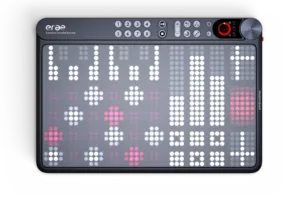
- Embodme Erae 2: since firmware 2.1 it also records gestures into a sequencer, but it is a touch playing surface, not a control desk.
- The DAW: an LFO in Ableton Live or Bitwig does the same job, as long as there is a computer on stage. That is exactly what the Drop avoids.
Other firmware updates are collected in our firmware updates section.