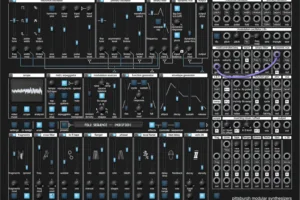
Audio Damage Sandbender: a four-operator FM synth built to be programmed
Audio Damage releases Sandbender, a four-operator FM synth with a wavefolder, filters, a low pass gate, MPE and a genetic preset generator, at $99 on desktop and $6.99 on iOS.

Audio Damage released Sandbender on 9 November, a four-operator FM synthesizer for macOS, Windows, Linux and iOS. The developer starts from something every FM user knows: people love the sound and dread the programming. Sandbender keeps FM at the core but surrounds it with a shaping stage, a proper filter, a low pass gate and tools that take the guesswork out of programming. It costs $99 on desktop and $6.99 on the App Store. This article is based on the official Audio Damage product page.
FM in one sentence
In FM synthesis, one oscillator, called an operator, modulates the frequency of another; the ratio between their frequencies and the depth of modulation decide which harmonics come out. Ratios and modulation index are explained in our article FM synthesis: operators, ratios and index.
The architecture
Four operators, ten algorithms or your own
An algorithm is the way operators modulate each other. Sandbender ships ten and an editor for drawing your own routings; any operator can be heard and modulate at the same time. Tuning works by harmonic ratio, free ratio or fixed frequency, and global controls (Xmod, Regen, Detune, Spread, a 32’ to 2’ range) act on the whole stack.
Warp, Fold, sub and noise
- a one-knob Warp shaper on every operator, morphing from triangle through sine to pulse;
- a wavefolder, symmetric, asymmetric or soft clip, applied to what you hear rather than to the modulation;
- a sub oscillator one or two octaves below operator 1;
- six noise types: white, pink, velvet, digital, crackle and metal.
Filter and low pass gate
Eleven filters (state-variable, ladder, diode and Sallen-Key, in low pass, high pass and band pass) run in stereo in every voice. Each voice ends in a plain VCA or a modelled low pass gate: a stage that closes volume and brightness together, for the plucked attacks and woody decays of West Coast synthesis.
Modulation, MPE and effects
| Area | What Audio Damage lists |
|---|---|
| Sources | 2 ADSR envelopes, 2 LFOs, 2 function generators, a 16-step per-voice sequencer, 4 macros |
| Routing | drag a source onto almost any knob |
| Expression | full MPE, MTS-ESP microtuning |
| Voices | 8 voices, poly, mono and retriggered mono |
| Effects | 6 of the company’s effects, in any order |
| Presets | over 260, in 9 categories |
MPE lets pitch, pressure and timbre vary note by note; see our article aftertouch, polyphonic aftertouch and MPE explained.
GENETICS and PERFORM
For those who would rather not program, the GENETICS page grows variations of the current sound: you choose which parts of the patch may change, and Sandbender draws a family tree of offspring to audition and breed from. The PERFORM page gives two nodes to move with a mouse or fingers, each axis driving a macro or a control, plus a tempo-synced gesture recorder of 1 to 8 bars.
Who it is for
Sandbender is for players who like the sound of FM but find DX7 emulations too austere to program, and for anyone who wants an FM synth that goes beyond bells and electric pianos. Linux support, still rare among commercial developers, and an iOS version on the same engine also make it a consistent tool between studio and mobile setups.
Price
- desktop: $99 from Audio Damage, perpetual licence, no copy protection or subscription; CLAP, VST3 and AAX on Windows 10 and later, CLAP, VST3, AU and AAX on macOS 10.15 and later (Intel and Apple Silicon), CLAP and VST3 on Ubuntu 22 and later;
- iOS: $6.99 on the App Store, as AUv3 and standalone, from iOS 16.
A full demo, limited to 20-minute sessions with saving disabled, is available. The formats are explained in our guide VST3, AU, AAX and CLAP plugin formats.
How it compares
- Dexed, free and open source, recreates the DX7’s six operators and 32 algorithms and loads its banks: unbeatable for the original sound, but with no filter or effects;
- Operator, bundled with Ableton Live Suite, shares the four-operator base and adds a filter, but stays locked inside Live;
- Native Instruments’ FM8 goes further on operator count (six, plus noise and a filter in its matrix), with a more technical interface.
Sandbender stands out for what happens after the FM (wavefolder, low pass gate, stereo filters), for MPE and its preset-generation tools, and for a copy-protection-free licence across four platforms. On the hardware side, the LOVE Synthesizers First Love takes another approach to FM. More releases are in our synth plugins section.