
GForce Oberheim Matrix-12: the 1985 matrix synth as a plugin, with MPE
GForce releases an official Oberheim recreation of the Matrix-12: 12 voices, a 15-mode filter, the full matrix and MPE, at $119.99 ($83.99 at launch).
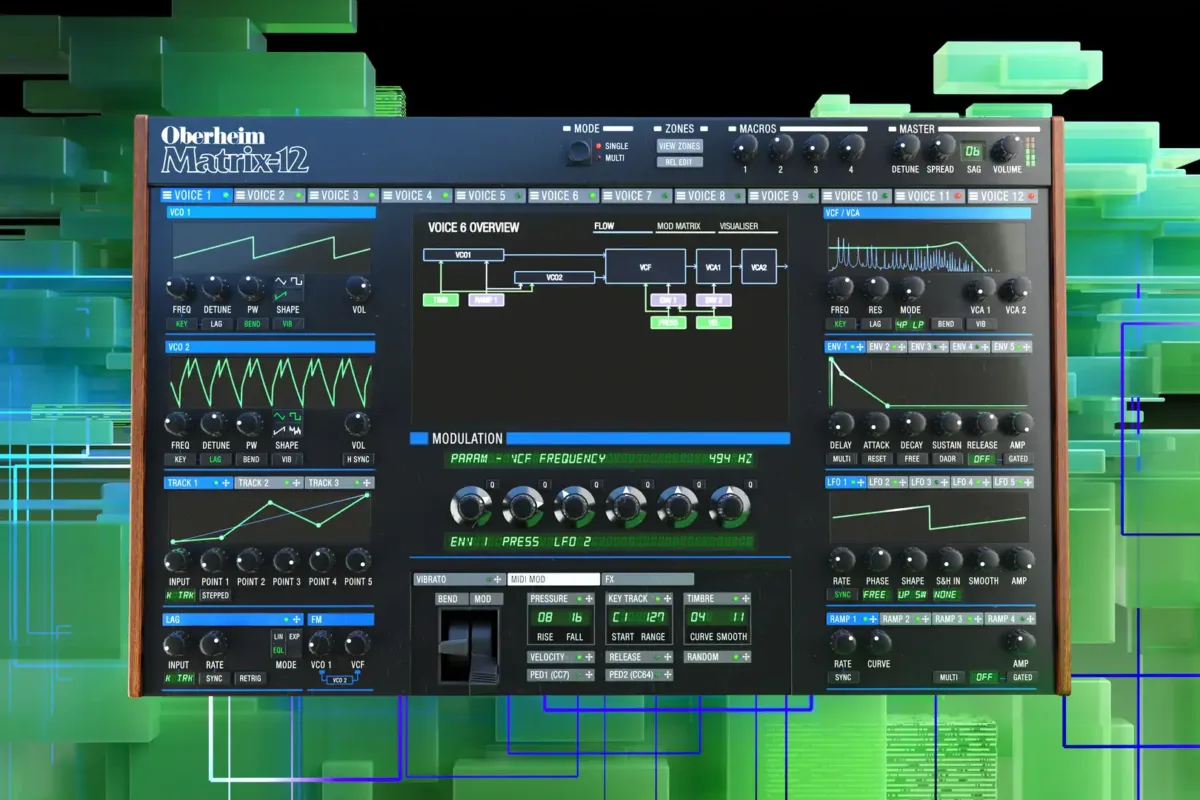
GForce Software released its Oberheim Matrix-12 on 5 November 2026: a software recreation of the 1985 polysynth sold under the Oberheim name, like its OB-E, SEM and DMX. It keeps the original’s two-oscillator voice and modulation matrix, adds MPE, macros and two effects, and lists at $119.99, or $83.99 at launch, according to GForce’s product page.
What the plugin does
The original Matrix-12 is a twelve-voice analog synth famous for its modulation matrix: any source can drive any parameter. GForce keeps that idea and builds each voice like this.
Sound engine
- Two VCOs per voice (the oscillators that make the raw sound) with triangle, saw and pulse; the second adds noise and hard sync, which resets its phase to the first for biting tones. Frequency modulation (FM, one wave modulating another’s pitch, see our FM synthesis explainer) is also on board.
- A 15-mode filter: 1- to 4-pole low-pass, high-pass, band-pass, notch, phase and combinations.
- Two VCAs in series per voice (the amplifiers that shape volume).
- A stereo delay and a reverb at the output.
Modulation and playing
- Per voice: five envelopes, five LFOs, four ramps, three trackers (which reshape a source’s curve), a lag processor (smoothing) and vibrato. Six bipolar slots per parameter, with quantise. For envelopes, see our ADSR guide.
- Three views to keep track: flow diagram, matrix grid and a per-module visualiser.
- Single mode (polyphony, unison, detune, stereo spread) or Multi mode with six overlapping keyboard zones, each with its own micro arpeggiator.
- Velocity, release velocity, pressure and full MPE (MIDI Polyphonic Expression, which sends each finger’s gesture separately), plus four global macros.
- Over 570 patches, including more than 190 original Matrix-12 and Xpander programs.
Who it is for
Players who want an American-style polysynth but are mostly after deep modulation: evolving pads, sequence sounds, animated textures. The six-zone Multi mode targets layered keyboard playing, MPE the owners of an expressive controller. Anyone after a simple Oberheim already has the OB-E or OB-X from the same developer; the Matrix-12 asks you to learn a matrix.
What it costs
| Item | GForce listing |
|---|---|
| List price | $119.99 |
| Launch price | $83.99 (end date not given on the product page) |
| Formats | Standalone, AU, AAX, VST2, VST3 (no CLAP) |
| Systems | macOS 10.15 or later (Intel and Apple Silicon), Windows 7 or later |
| Memory | 8 GB RAM |
| Trial | free 14-day demo |
It is a one-time purchase, no subscription. Missing CLAP matters little in most hosts but counts for Bitwig users: formats are covered in our VST3, AU, AAX and CLAP explainer.
What it competes with
- Arturia Matrix-12 V, sold alone or in V Collection: the long-installed reference, with its own take on the matrix. GForce leans on the Oberheim licence, the original factory programs and MPE.
- IK Multimedia Syntronik 2 and its M-12 instrument, built from Matrix-12 samples: quicker to program, without the full matrix.
- Full Bucket MatriQ-Six, free, which emulates the smaller Matrix-6: a good way to try the architecture before paying (our coverage).
No listening verdict here: official demos are on GForce’s YouTube channel, and the 14-day demo lets you judge for yourself. More recreations of vintage gear live in our Vintage Emulations section, and voices, polyphony and unison are explained in our voice count explainer.


