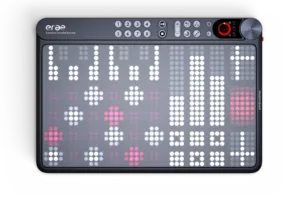
Audiothingies MicroMonsta 2 firmware 3.0 adds polyphonic aftertouch and per-note chords
A free update for the MicroMonsta 2: polyphonic aftertouch, 21 scales and 63 chords assignable note by note, a 16-step modulation sequence and a 12-slot matrix.

Audiothingies, a small French maker, has released firmware 3.0 for the MicroMonsta 2, its desktop digital synth with two polyphonic parts. The update is free. It barely touches the sound engine, but it changes how the box plays: polyphonic aftertouch, scales and chords set note by note, a 16-step modulation sequence and a modulation matrix expanded to 12 slots. This article is based on Audiothingies’ product page and the official MicroMonsta 2 changelog. The news was reported on November 5 by Synth Anatomy.
What firmware 3.0 adds
Scales and chords, note by note
The internal keyboard, the scaler (which forces played notes into a scale) and the chorder (which turns a single note into a chord) have been rewritten. They now offer 21 scales and 63 chord types: 27 three-note and 36 four-note voicings, from open triads to rootless ninths, fourth stacks and clusters. The most useful change fits in one line of the changelog: you can assign a different chord to each note of the scale. C can trigger a seventh chord while D plays an add9, so a whole chord progression can be played with one finger.
Two practical details: these functions now respond to MIDI input, so an external keyboard or sequencer benefits too, and their settings are saved per preset instead of globally as in version 2.
Polyphonic aftertouch
Aftertouch is the pressure applied to a key that is already held down. With channel aftertouch, one value applies to every note; with polyphonic aftertouch, each note has its own, so you can open the filter on a single note of a chord. The MicroMonsta 2 now accepts both: according to Audiothingies, a preset set up for aftertouch responds to either without extra configuration. The spec sheet also lists MPE support, the protocol that sends pitch, pressure and slide independently for each note.
A 16-step modulation sequence
The arpeggiator gains a second 16-step sequence dedicated to modulation. Each step outputs a low, mid, high or random value in sync with the arpeggio. It becomes a modulation matrix source, unipolar or bipolar, and can affect the whole program or only the generated note. It is the tool for rhythmic patterns where the filter or level changes on every step.
A wider matrix
The modulation matrix grows from 10 to 12 slots per program. New destinations include delay time, feedback and level, reverb level, envelope sustain (one envelope or all three together), shape for every oscillator and arpeggiator gate time, up to overlapping notes for legato slides. Sustain is the envelope stage held for as long as the key stays down; our ADSR envelope guide covers all four stages.
Filter, saturation and playability
- Reworked filters: resonance self-oscillation level is now constant across the whole frequency range, and the LP1 low-pass now self-oscillates like LP2, LP3 and LP4.
- Two resonance responses replace the four old modes: MM2, the original and recommended response, and VNT, with half compensation, which Audiothingies compares to the Oberheim Matrix-12 (GForce has just released the official emulation).
- Soft clipping reworked “for a more analog sound”, according to the maker. Voice drive set to 0 is now fully disabled.
- Scale mode for the pots, on by default: values no longer jump when you turn a knob whose position does not match the stored setting. Jump mode is still available in the settings.
- Coarse tuning on all three oscillators now spans −24 to +24 semitones (up from −24 to +12).
Before you update
The changelog lists several compatibility points worth reading before installing:
| Situation | What Audiothingies says |
|---|---|
| Unit on firmware 1.x | update to 2.x first, then to 3.x |
| First boot after 2.x | stored data converted to the new internal format, system settings reset to defaults |
| v2 SysEx files | still importable; v1 SysEx import is no longer supported |
| Editors built for v2 | not compatible with v3 |
A full SysEx backup of your programs before updating is the basic precaution, especially if you rely on a third-party editor designed for version 2.
Who it is for, what it costs, what it competes with
Who it is for: current MicroMonsta 2 owners first, since the update is free. Then players looking for a very compact, USB-powered polyphonic digital synth to drive from a master keyboard or sequencer: the format suits a travel setup as well as a corner of the desk. Per-note scales and chords will appeal to people who write music without being keyboard players; polyphonic aftertouch to those who already own a compatible controller.
What it costs: the MicroMonsta 2 sells for €318 including VAT on Audiothingies’ own shop, which lists limited stock in November and more in December. Firmware 3.0 is free.
What it competes with: among small polyphonic digital synths, the Arturia MicroFreak has a built-in touch keyboard but stays at 4 paraphonic voices (voices that share one filter, as explained in our guide to polyphony and paraphony), while the MicroMonsta 2 offers 12 real voices or two 6-voice parts. The Korg volca fm2, another compact box, is limited to FM synthesis on 6 voices. On the other hand, the MicroMonsta 2 has no keyboard and no step sequencer: it needs an external controller to show what it can do, and its only audio output is a stereo minijack.
Specs at a glance
- 12 voices in monotimbral mode, 2 × 6 voices bitimbral, Combi mode (stacks and splits)
- 3 oscillators per voice: 12 analog-style types, 4 FM types on OSC1, 8 multisampled wavetables on OSC2 and OSC3
- 8 filter types with FM, 3 envelopes and 3 LFOs per voice
- 300 program slots and 100 combi slots
- USB-B (power and MIDI), 3.5 mm TRS MIDI input (Type A), 3.5 mm stereo line/headphone output
Audiothingies’ official demo:
Firmware 3.0 is available from the MicroMonsta 2 page, along with an online updater. Other recent updates are collected in our Firmware Updates section.
View at Thomann