KOMA Elektronik Haloplane: a sampler you play with electromagnetic pickups
KOMA Elektronik opens pre-orders for the Haloplane, a micro-loop sampler played with electromagnetic pickups. Who it is for, what it costs, what it competes with.

Berlin-based KOMA Elektronik has opened pre-orders for the Haloplane, a tabletop instrument it describes as an electromagnetic micro-loop sampler. Designed with Passepartout Duo, it uses the same pickups as the Chromaplane, the company’s electromagnetic instrument, but plays recorded loops or wavetables. Announced list price: €648, with cheaper pre-order tiers until November 27 and first deliveries in early 2027. Source: KOMA Elektronik’s official product page.
A sampler you play with pickups
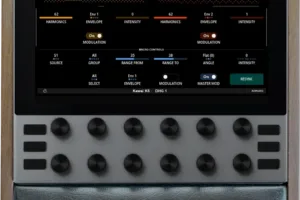
The Haloplane’s surface holds seven electromagnetic fields. Each one constantly emits a sound, and you hear it by moving two hand-held pickups, coils that capture the field, over the top. You play with hand position and motion, not a keyboard.
Each field holds a short loop of up to 4 seconds, recorded on the spot through the built-in microphone or the line input. The Haloplane slices the recording automatically: the length parameter sets the size and number of slices, position morphs smoothly between them, and pitch transposes. Every field has its own LFO, a low-frequency oscillator that moves a setting on its own, which gives textures close to granular synthesis.
Wavetables on the same principle
A very short sample is processed as a wavetable: six waveforms that the position parameter crossfades between. Wavetable synthesis is explained in our article on Roland n/vision wavetable synthesis. A companion app includes an editor for building tables in the expected format.
What KOMA Elektronik announces
- Seven customizable fields, each with its own pitch, length, position and modulation settings, and its own LFO.
- Stereo electromagnetic pickups, the same as on the Chromaplane.
- Field rotation: sounds move from field to field for riffs or timed sequences; the rotation CV input has three modes (trigger, rotation, phase reset).
- A state-variable multimode filter and a selectable effect (delay, reverb, flanger, chorus, bit-crusher), each with a CV input.
- Two CV outputs: a stereo envelope follower and a modulation output that turns pickup activity into voltage.
- A USB audio interface mode with 7 outputs, compatible with macOS, Windows and Linux, to play any DAW track through the fields.
- Up to 100 user presets and scales, stored on SD card.
- USB-C power with no internal battery: any USB power bank will do.
CV, or control voltage, is how modular synths control one another; our CV and Gate guide explains how it works. The companion app opens in the browser of any device connected to the Haloplane over Wi-Fi, no internet needed; KOMA says the instrument also works fully without it.
KOMA Elektronik has published an in-depth video presentation:
Who it is for
- Ambient and improvising musicians looking for a gestural instrument, where you sculpt sounds captured around you rather than play notes.
- Modular system owners: rotation, filter and effect accept CV, and the two modulation outputs can drive other modules in turn.
- Studio producers, thanks to the seven-output USB mode that turns the instrument into a processor for existing tracks.
- Less suited to anyone after a conventional sampler with pads and a sequencer: the Haloplane has neither.
What it costs
KOMA Elektronik announces a list price of €648. During the pre-order, open until November 27, pricing follows tiers: the product page currently shows €550, and each buyer gets the lowest tier still available. Units are built in batches, first come first served, with first deliveries in early 2027 and a limit of two units per customer.
| Item | KOMA Elektronik announcement |
|---|---|
| List price | €648 |
| Pre-order | €550 at the current tier, until November 27 |
| Delivery | first units in early 2027 |
| Power | USB-C, no battery |
What it competes with
- KOMA Elektronik Chromaplane: same instrument family and same pickups, but its fields are driven by oscillators; the Haloplane complements it with recorded loops rather than replacing it.
- Make Noise Morphagene: a Eurorack tape and microsound module with deep CV control, but it needs a modular case and is played with knobs, not gestures.
- Bastl Instruments Microgranny 2: a much cheaper pocket granular sampler, monophonic and without CV inputs.
The Haloplane stands out for its hand-played approach and its seven USB outputs; how it sounds in practice will be clear once the first batches ship. More new hardware is in our announcements section.