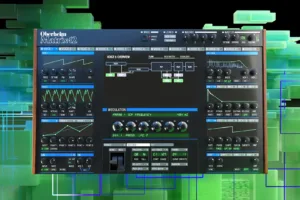
Schmidt Vi: the Schmidt Eightvoice synth becomes a €179 plugin
Schmidt Synthesizer releases Schmidt Vi, a software recreation of its eight-voice analog polyphonic synth developed with UJAM: four oscillators, 16 LFOs, MPE, €179 including tax, 7-day trial.

Schmidt Synthesizer has released Schmidt Vi, a software recreation of the Schmidt, the large eight-voice analog polyphonic synth first shown at Musikmesse Frankfurt in 2012. The plugin was developed with software company UJAM, following a prototype shown at Superbooth in May 2026. It sells for €179 including tax on the manufacturer’s store, with a free 7-day trial. At the same time, Schmidt says it will soon stop building the hardware instrument. This article is based on Schmidt Synthesizer’s official product page and the Schmidt Vi manual.
Who it is for
Schmidt Vi is aimed first at studio musicians who want a big analog polysynth sound for pads, brass and basses without the price of the original: the hardware, built in Germany with through-hole parts, was never a common purchase. It also targets existing Schmidt owners: the product page says they can control the plugin from their instrument’s own panel. Polyphony (how many notes can sound at once, eight here) and its variants are covered in our guide to polyphonic, paraphonic and monophonic voice counts.
What the plugin contains
Four oscillators and four filters
The engine follows the hardware: four oscillators with distinct characters, the fourth producing complex waveforms through several stages of ring modulation (multiplying two signals, which gives metallic, inharmonic tones). The signal then runs through two Moog-style multimode filters and two Oberheim-style dual filters, arranged in two parallel groups, and finally a 12 dB low-pass stage the manufacturer calls an “afterburner”. What the oscillator, filter and amplifier each do is explained in subtractive synthesis explained.
Sixteen LFOs, nine envelopes, no matrix
The plugin offers 16 LFOs and 9 envelopes, one of which can move the sound across the stereo field. FM (frequency modulation), PWM (pulse-width modulation) and ring modulation are all available. As on the hardware, there is no central modulation matrix: each modulation control sits in the section it affects. Envelopes are covered in our ADSR envelope guide.
What software adds
- Knobs show their actual value, which the hardware cannot do.
- A randomizer generates new sounds.
- The pitch wheel and aftertouch can target several destinations, and the plugin supports MPE, the standard that gives each note its own expression (see aftertouch, polyphonic aftertouch and MPE explained).
- The display can be set to a wide panel or a split panel.
- Several instances can run at once, so the hardware’s “multimode” feature was left out.
What it costs
| Item | Schmidt Vi |
|---|---|
| List price | €179 including tax (Schmidt Synthesizer store) |
| Availability | on sale now, free 7-day trial |
| Systems | Windows and macOS (installers provided) |
| Copy protection | iLok account and iLok License Manager required |
| Formats | not listed on the product page |
The product page does not list plugin formats, so the trial version is the way to check that it loads in your host before buying. The differences between VST3, AU, AAX and CLAP are summed up in our guide to plugin formats.
What it competes with
There is no shortage of big analog polysynths in plugin form. The closest in spirit is the GForce Oberheim Matrix-12, another twelve-voice giant from the 1980s, which takes the opposite approach with a central modulation matrix. The big developers’ emulation bundles also cover the Roland, Sequential and Oberheim classics. Schmidt Vi’s case is different: it recreates a recent instrument made in very small numbers that no other emulation covers, with four filter types in one engine. Its drawbacks are known in advance: iLok dependency, and a product page that lists neither formats nor minimum requirements. No verdict on the sound here: the free trial is there to judge for yourself. Other software recreations are gathered in our vintage emulations section.