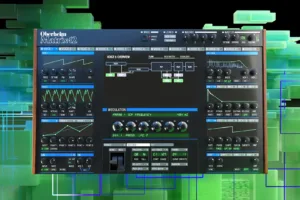
ImpulseDie: a patchable Pulsar-23-inspired drum synth for €9.99
Diego Capoccitti has released ImpulseDie, a semi-modular percussion synth inspired by the SOMA Pulsar-23: four voices, four loopers, 122 pins, €9.99 on desktop and $4.99 on iOS.

Italian developer Diego Capoccitti (34Audiovisuals) has released ImpulseDie, a semi-modular percussion synth patched with virtual cables and openly inspired by SOMA Laboratory’s Pulsar-23. It costs €9.99 as a plugin for Windows and macOS, and $4.99 on the App Store for iPhone and iPad, where it launched on 5 November. Source: Diego Capoccitti’s official product page.
Who it is for: learning drum patching without buying the hardware
ImpulseDie is aimed at musicians curious about the Pulsar-23 approach, a semi-modular drum machine where everything can be rerouted with cables, who are not ready to invest in the hardware. It also suits producers on the move: presets are shared between the desktop and iOS versions, and the iOS build runs standalone or as an AUv3 inside a host.
The developer is explicit: ImpulseDie is an independent product, not affiliated with, licensed by or endorsed by SOMA Laboratory, and it contains no SOMA code, circuit designs or samples. It is not an official emulation but a reinterpretation of the concept.
How it works
With no cables at all, ImpulseDie already plays: the clock drives the loopers, the loopers trigger the four voices, and the voices go to the mixer. Cables are there to break that chain, for instance to let the kick play the bass or the reverb clock drive the hi-hat.
One signal domain
As on the Pulsar-23, audio, envelopes, clocks and random steps are the same kind of signal. A kick can act as an LFO, an LFO as a clock. This is the logic of CV, the control voltage used by modular systems, explained in our guide to CV and Gate. The developer deliberately adds some noise, drift and bleed, as on analogue hardware; these can be turned down in the SETUP menu.
Loopers instead of a step sequencer
There is no step sequencer. Each voice has a tape-style looper that records when you touch the pad, how long you hold it and how hard you press. A short tap is a hit, a long press a held note or a drone. Each looper has four banks; a 4-bar loop is 128 clock ticks at 96 points per tick. A piano-roll view lets you draw the same information with the mouse.
The spec sheet
- Four voices: BD (kick), BASS (monophonic subtractive bass), SD (snare and clap), HHT (hi-hat and cymbal), each with an attack-release envelope that follows how long you hold the pad.
- 122 pins, 133 patch points in total, on a panel of 55 knobs, 10 selectors and 13 touch pads. Any output into any input, with normalling (a patched cable replaces the internal connection).
- Clock from about 1 to 1500 BPM, seven divided outputs, synced to the host or to MIDI clock.
- SHAOS, a pseudo-random generator with four outputs, step lengths of 63, 16 and 217, and a writable 16-step memory.
- LFO from one cycle every ten seconds up to about 5 kHz, so it doubles as a clock or a sound source.
- Delay and reverb in parallel with three modes (band-pass, double echo, pitch shifter), parallel distortion on the whole mix, and three audio file players.
- Outputs: a mono summing bus as on the hardware, plus six separate outputs (BD, BASS, SD, HHT, DELAY, REVERB) for a stereo mix in the host.
- MIDI: BASS on channel 1, BD, SD and HHT on channel 10, MIDI Learn on every knob, 80 automatable parameters.
- 148 factory presets in thirteen folders, most with a groove already recorded.
- Two builds under one licence: ImpulseDie (instrument, with side-chain on three inputs) and ImpulseDie FX, which runs its track’s audio through the machine.
What it costs
| Version | Announced price | Formats |
|---|---|---|
| Desktop (Windows, macOS) | €9.99, licence for 2 machines | VST3, AU, AAX |
| iOS and iPadOS 15 or later | $4.99 (US App Store) | standalone app and AUv3 |
A 15-day demo with no feature restrictions is available for macOS and Windows.
What it competes with
- SOMA’s Pulsar-23, the original hardware designed by Vlad Kreimer: a real analogue circuit, physical controls and a very different budget. ImpulseDie borrows its logic for the price of a coffee, without claiming to reproduce the circuit. The Pulsar-23 is available: View at Thomann
- Recent analogue drum machines such as the Gene Synths GENE 616 or the Dreadbox Alecto: hardware with a sequencer, but without ImpulseDie’s free patching.
- Conventional software drum synths that pair synthesised voices with a step sequencer: quicker for programming a precise beat, less suited to the slides between rhythm, noise and drone that ImpulseDie’s looper allows.
More software recreations of instruments are collected in the emulations section, including the recent Schmidt Vi.
Watch
The product page links to this full walkthrough by Gavinski:
Full details, demo and manual: ImpulseDie page at Diego Capoccitti. iOS version: ImpulseDie on the App Store.