Frap Tools Magnolia firmware 1.2 brings 499 programs and a librarian
Free Magnolia firmware 1.2 raises memory to 499 programs, adds three knob modes and ships with a free librarian for macOS and Windows.
Frap Tools, the Italian maker best known for its Eurorack modules, released firmware 1.2 for Magnolia, its first keyboard synthesizer, in late November. The update is free and comes with the Magnolia Librarian, a free program manager for macOS and Windows. This article is based on the official product page, which hosts the downloads, and on the two presentation videos published by Frap Tools, whose descriptions list the changes.
What the Magnolia is
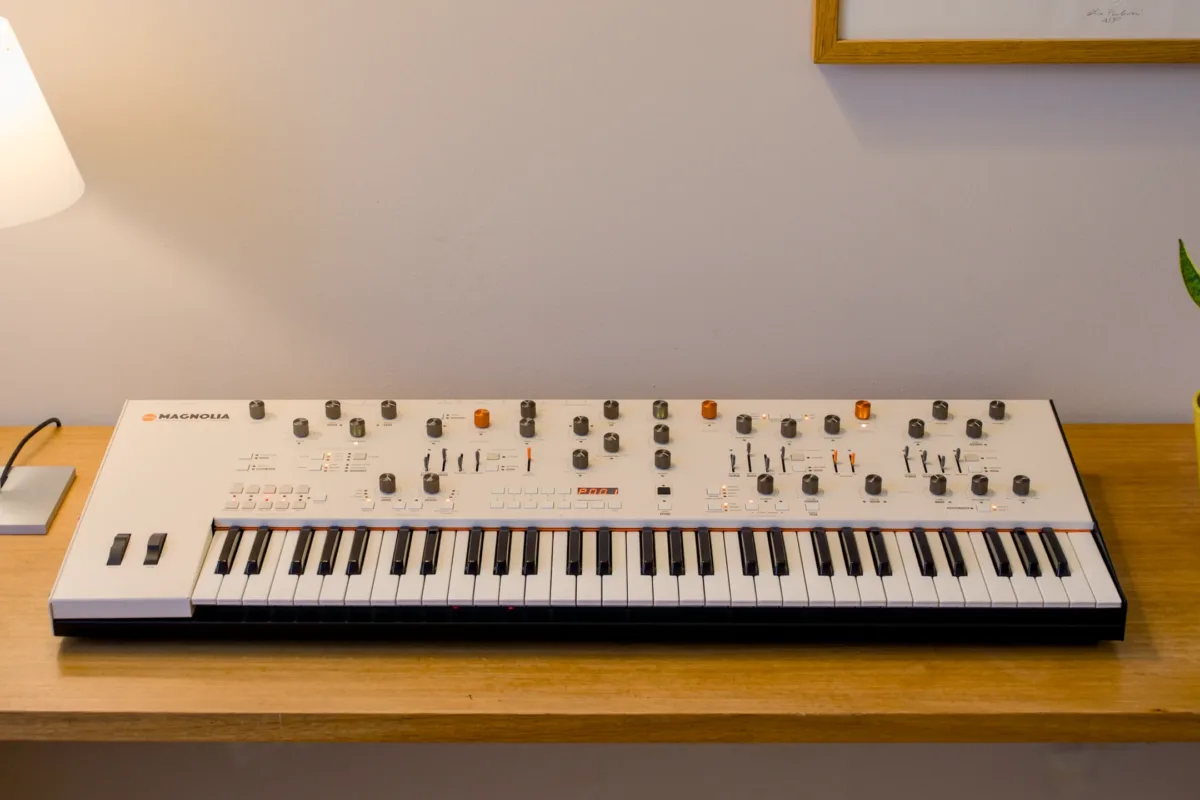
The Magnolia is an eight-voice analog polyphonic synthesizer. According to the maker’s spec sheet:
- two oscillators per voice: an “east coast” one with pulse width modulation, a “west coast” one with linear through-zero FM (TZFM), wavefolder and sync;
- an 18 dB/octave high-pass filter and a resonant 24 dB/octave low-pass, both with linear FM, fed by analog saturation;
- a 61-key Fatar keybed with velocity and polyphonic aftertouch;
- two parts per program, 16 modulation sources and 64 modulation slots per part;
- stereo analog distortion and two digital effect slots (chorus, delays);
- USB-C, MIDI In, Out and Thru, a sustain input and two expression pedal inputs.
FM, or frequency modulation, means varying one oscillator’s pitch at the rate of another; our FM synthesis explainer covers the settings. Polyphonic aftertouch, which reads the pressure on each key separately, is explained in our aftertouch and MPE guide.
What firmware 1.2 adds
More memory
The Magnolia now stores 499 programs and 9 set lists, ordered lists of programs for the stage. Firmware 1.10 had already raised memory to 400 programs.
Three knob modes
When a program is recalled, the physical knob positions no longer match the stored values. Firmware 1.2 lets you choose how the synth reacts when a knob is turned. Scaled becomes the default: it avoids a sudden filter jump mid-song while still responding from the first movement.
Playing and editing
- the display shows voice allocation for parts A and B;
- control and modulation values can be fine-tuned with the Value button and arrow buttons;
- new pitch wheel behaviours, set per part: the bend can apply only to the last note played or to the highest note, handy for bending a lead line over a held chord;
- support for the Magnolia Librarian;
- fixes: control and wheel behaviour, display glitches, MIDI over DIN.
The Magnolia Librarian
The librarian connects to the synth over a single USB-C cable and shows all 499 programs at once. It lets you:
- name, tag, search and rearrange programs;
- name set lists and build them from tags;
- import and export programs;
- keep a backup every time it reads the instrument;
- install future firmware step by step.
It is not a sound editor yet: program parameters cannot be changed from the computer. A new factory pack adds category tags to the 100 factory programs. It is the same kind of tool as Waldorf’s Chutney librarian for the Protein.
Who it is for
- stage keyboard players who switch programs and need set lists and knobs that do not jump;
- studio players building up a sound library who want to sort and back it up from a computer;
- existing Magnolia owners, who get all of it for free.
What it costs
Firmware 1.2 and the Magnolia Librarian are free to download from the product page. Frap Tools does not show a list price for the Magnolia on its site: price not disclosed by the maker, the instrument is sold through dealers. View at Thomann
What it competes with
- Moog Muse and Oberheim OB-X8: two other eight-voice analog keyboards that lean on a heritage brand sound. The Magnolia stands apart with its analog through-zero FM and polyphonic aftertouch.
- Third-party editors: on many synths, program management goes through independent or paid software. Here the maker supplies the tool itself, for free.
To compare multi-voice architectures, see our polyphony and paraphony explainer. Other updates are collected in our firmware updates section.