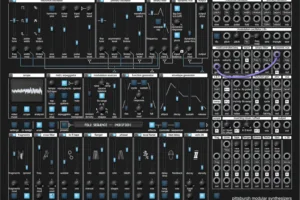
zc devices Thicket: a polyphonic modular synth plugin for $99
zc devices has released Thicket, a 50-node polyphonic modular synth with MPE support, in VST3, AU and CLAP for Windows, macOS and Linux: $99 until 30 November, then $159.

Small developer zc devices released Thicket on 16 November, a software synth it describes as an expressive polyphonic modular synthesizer. The aim is to bring the modulation freedom of a modular system to a polyphonic instrument, without making you build everything from basic components. It costs $99 until 30 November, then $159, as a perpetual licence with free updates. Formats are VST3, AU and CLAP, on Windows, macOS and Linux. Source: the official zc devices product page.
Who it is for: sound designers who want to patch without menu diving
Thicket targets players who find a fixed-architecture synth too rigid but do not want to spend an evening wiring oscillators, VCAs and envelopes before hearing a note. The developer sums up the approach in one line: nodes are molecules, not atoms. Each node is already a complete instrument or effect, and zc devices promises a playable patch within the first minute.
It should also appeal to two often-overlooked groups: Linux users, served in VST3 and CLAP alongside Windows and macOS (our guide to VST3, AU, AAX and CLAP plugin formats explains what each format changes), and owners of an MPE controller, the keyboards and surfaces that send separate expression data for every note.
What is inside Thicket
The product page lists 50 nodes, connected on screen with virtual cables:
- 9 engines: DCO Engine and Dual DCO for the character of digitally controlled analogue polysynths, Stack and Hyper Engine for detuned voice stacks up to a 9-voice super-saw, Wavetable Engine, Operator for FM, Sample Engine, Noise Engine and Sub Engine.
- 6 filters: a main filter, a “Vintage LPF” ladder, an aggressive filter, a comb filter, a formant filter and a four-band EQ.
- 11 modulation sources: LFOs, envelopes, a sequencer, an input follower, velocity, mod wheel, MIDI CC, macros and the three MPE dimensions (pressure, slide, pitch).
- 24 effect and mixing nodes: reverbs (including a shimmer and one with a freeze function), delays including a tape echo, granular, BBD and ensemble choruses, phaser, ring modulation, rotary, distortions, wavefolder, bitcrusher, compressor, mixers and a multiband splitter.
Modulation with no fixed depth
Every source is routed visually to any parameter, other modulators included: an envelope can modulate the rate of an LFO that itself modulates a follower, “as deep as your CPU allows”, the developer says. Envelopes are explained in our article on the ADSR envelope; here the global amp envelope is drawn directly with the mouse, with an adjustable curve for each stage.
Manual and “synthetic” macros
Four renamable user macros can each drive as many targets as needed. Thicket adds synthetic macros, built automatically from the patch content: on the official screenshot they are called Character, Tone, Modulation and Stereo. They are meant for quick tweaks to a preset without opening the graph.
Wavetables, samples and FM
The wavetable engine loads up to five wavetables and morphs between them, with four phase-warp modes (Bend, Sync, Mirror, FM). The Sample Engine turns Thicket into a sampler: drop a file on the node and play it across the keyboard. The Operator node, the building block for FM, has four modulation inputs: use it alone for DX-style tones or feed it from any engine. The basics are covered in our guide to FM operators, ratios and index.
MPE as a first-class feature
Pressure, slide (the vertical axis on the key) and pitch are handled per note, with adjustable smoothing and a mode that decides how several notes merge when they share a target (newest, maximum or average). In hosts that support VST3 Note Expression, such as Bitwig and Cubase, MPE pitch bend reaches ±48 semitones. Without an MPE controller, pressure and slide can be remapped to the mod wheel or a CC. The difference between aftertouch, polyphonic aftertouch and MPE is explained in our dedicated explainer.
What it costs
| Item | zc devices announcement |
|---|---|
| Launch price | $99 until 30 November 2026 |
| Regular price | $159 |
| Licence | perpetual, free updates (new nodes included) |
| Formats | VST3, AU, CLAP |
| Systems | Windows 10 or later (x64), macOS (universal, Intel and Apple Silicon), Linux (x64, VST3 and CLAP) |
It is sold directly from the developer’s website. The maximum voice count is not stated on the product page.
What it competes with
- VCV Rack: free as a standalone app, it recreates a Eurorack system module by module. It is larger and more open, but you patch at the level of individual oscillators and VCAs, and the plugin version is paid. Thicket takes the opposite route: less granularity, nodes that are already complete.
- Bitwig Studio’s The Grid: a very rich polyphonic modular environment, but only available inside Bitwig. Thicket runs in any host.
- Native Instruments Reaktor: the long-standing build-your-own-synth reference, far deeper, but designed for low-level programming and with no Linux version.
If you would rather go modular in hardware, our article Eurorack explained: choosing your first case covers the basics. Other recent releases are collected in the synth plugins section.
Listen
zc devices has published a walk through its factory presets:
Price, formats and specifications: Thicket product page at zc devices. Version 1.0 manual: Thicket PDF manual.