soundmachines DYNAMO adds velocity and aftertouch to synths that never had them
soundmachines opens pre-orders for DYNAMO: four sensors under your instrument turn pressure, velocity and movement into MIDI, CV and analog effects. Who it is for, what it costs, what it competes with.

soundmachines has opened pre-orders for DYNAMO, a performance controller that adds pressure, velocity and movement to instruments that lack them, vintage synths first among them. The approach is unusual: instead of replacing the keyboard or opening up the instrument, DYNAMO puts four force sensors under its feet and measures how the weight shifts as you play. This article is based on the official DYNAMO page at soundmachines.
How it works
Every key press transfers force into the body of the instrument. The four sensors, called pods, measure it continuously and the controller converts it into control signals. The instrument stays original: no replacement keyboard, no internal mods.
Setup takes four steps: one sensor under each foot (the instrument has to stand on four stable points and weigh roughly 5 to 30 kg), connecting the sensors to the controller, a calibration that measures the resting weight and then the pressure range of your playing, and finally choosing an output. Gain, offset and threshold (which prevents accidental modulation) are set from the front panel and saved as per-instrument presets.
What DYNAMO can generate
Control signals
- Continuous pressure, sent over MIDI as channel aftertouch (one pressure value shared by all notes, unlike polyphonic aftertouch, explained in our aftertouch and MPE guide), as MIDI CCs, as device-specific SysEx or as control voltage.
- Velocity derived from the initial impact: on a compatible MIDI synth, you switch off the internal keyboard-to-engine link (Local Control) and route the notes through DYNAMO, which sends them back with calculated velocity.
- X-Y control: by comparing the four readings, DYNAMO works out the center of pressure and derives two axes from it, for example filter cutoff and resonance. On a monophonic keyboard it can also estimate which part of the keyboard is being played.
- Triggers: in four-zone mode, tapping a corner of the instrument sends a gate or a MIDI note; in four-pods mode, each sensor becomes an independent performance input.
Analog audio processing
Even if the instrument has no MIDI, CV or expression input, its audio can be routed through DYNAMO. The stereo analog path uses SSI2144 four-pole resonant filters and SSI2164 VCAs (voltage-controlled amplifiers): filter sweeps, wah, tremolo and panning then follow your pressure, or internal LFOs.
soundmachines has posted demos on a Crumar Spirit, an Elka Synthex, a Korg MS-20 and a Roland JX-3P. This one drives the Crumar Spirit’s filter:
Connections
| Item | Manufacturer spec |
|---|---|
| MIDI | 5-pin DIN in and out, USB MIDI |
| CV | 4 configurable CV/gate outputs, 1 expression pedal emulation output |
| Sensors | 4 inputs, 3.5 mm TRS cables |
| Audio | Mono or stereo input, stereo output |
| Power | USB-C (power and MIDI) |
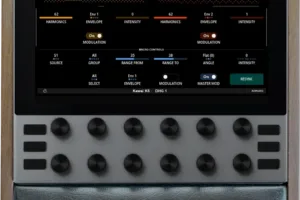
| Front panel | OLED screen, encoder, gain, offset and threshold knobs, 4 quick presets, MIDI panic button |
| In the box | Controller, 4 sensors, 4 3.5 mm TRS cables, 1 USB-C cable |
The CV/gate outputs talk to analog synths with modulation inputs and to modular systems; our guide Eurorack explained covers how control voltages work. soundmachines notes that the enclosures shown are prototypes and that pre-orders are for the production version.
Who it is for
- Owners of vintage synths without velocity or aftertouch who want more expression without touching their instrument’s electronics.
- Stage keyboard players who want to open a filter or move the sound across the stereo field by leaning into the keys, hands never leaving the keyboard.
- More niche, but listed by the maker: drum machines, guitars, or driving a Pure Data or Max patch from the four sensors.
- Less suited to light instruments (under roughly 5 kg) or ones on a stand that does not rest on four stable points.
What it costs
soundmachines quotes its prices excluding VAT:
- €300 for the first 100 kits (Super Early Bird), then €350 (Early Bird);
- €500 planned retail price once the product goes on general sale;
- €750 for a bundle of three kits, limited to 40 bundles; €70 for an extra set of four sensors;
- shipping: €30 per order.
The pre-order runs for 30 days and closes on December 17, 2026 at 14:00 CET. Shipping is planned for late January 2027, with store and dealer availability expected between late January and early February 2027. DYNAMO cannot be bought in between.
What it competes with
- Expressive E Touché SE: an expression controller you place next to the keyboard and play with your free hand. It does not read your playing on the keyboard itself, and has no analog audio path.
- A master keyboard with aftertouch plus a MIDI-to-CV interface: the classic way to play an analog synth with expression, but it means playing a different keyboard from the instrument’s own.
- A plain expression pedal: the cheapest route if the synth has the right input, but it ties up a foot and gives neither velocity nor X-Y control.
More new hardware tracked by the site is in the announcements section.