
Pittsburgh Modular releases Lifeforms SV-1v and Voltage Lab V plugins
Pittsburgh Modular releases two software emulations of its synths: the East Coast Lifeforms SV-1v and the West Coast Voltage Lab V, at $49 each.
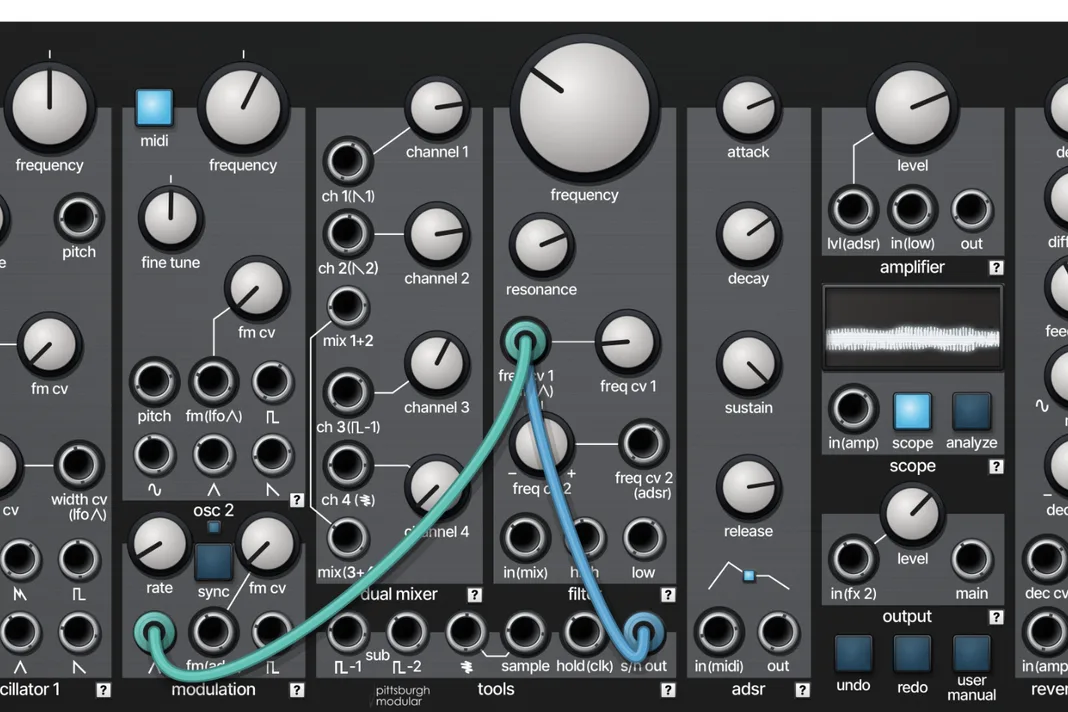
Pittsburgh Modular is growing its software range. Two weeks after the Microvolt 3901, the US maker introduced two more emulations of its hardware synths on November 11 in its official announcement: Lifeforms SV-1v, a software version of its best-selling East Coast synth, and Voltage Lab V, based on its West Coast Voltage Research Laboratory. Each costs $49 on macOS and Windows, with a 7-day free trial.
Two schools of synthesis, one method
Pittsburgh Modular calls its software instruments component-level emulations, built from the schematics of the original hardware: the company says it modeled how each circuit works rather than imitating the sound by ear. Both plugins are patchable: virtual cables carry audio and CV (control voltage, the signal that drives a parameter) between modules, effects included. The basics of modular patching are covered in our guide Eurorack explained: the format and your first case.
Lifeforms SV-1v: subtractive synthesis the Pittsburgh way
The SV-1v follows the East Coast school associated with Moog: harmonically rich oscillators, shaped afterwards by a filter. That is subtractive synthesis, built here around two oscillators modeled on the Lifeforms SV-1b hardware and the Pittsburgh Filter, the low-pass filter the company describes as the core of its sound since day one.
- two wide-range oscillators, a four-channel mixer, a resonant filter, an ADSR envelope and an amplifier;
- seven effects, used at the end of the chain or patched inside the synth: Analog Delay, Verb 28, Local Florist, Reverb, Phaser, Chorus and Pittsburgh Folder;
- monophonic or six-voice polyphonic playing, where the hardware is monophonic;
- more than 200 factory presets, plus a built-in oscilloscope and spectrum analyzer.
Voltage Lab V: the West Coast side
Voltage Lab V follows the other great school, West Coast synthesis, inherited from Don Buchla: you start from a simple tone and add harmonics, instead of filtering a rich one. Its building blocks are a complex oscillator (two linked oscillators, one modulating the other), a wavefolder (a circuit that folds the waveform back on itself to create harmonics), function generators and a low pass gate, a combined filter and amplifier with a naturally percussive response. According to Pittsburgh Modular, the original Voltage Lab was the first synth able to fold harmonically rich waves such as saws and squares. The software version also adds six-voice polyphony and more voltage-controlled effects.
Specifications
| Item | Lifeforms SV-1v | Voltage Lab V |
|---|---|---|
| Emulated instrument | Lifeforms SV-1 (East Coast) | Voltage Research Laboratory (West Coast) |
| Polyphony | mono or 6 voices | 6 voices |
| macOS | 12 Monterey or later, Apple silicon or Intel: AU, VST3, standalone app | |
| Windows | 10 or 11 64-bit, including ARM64: VST3, standalone app | |
| iPad | iPadOS 15 or later: standalone app and AUv3, with built-in touch keyboard and 16-step sequencer | |
| Desktop price | $49 | $49 |
| iPad price | $17.99 | $19.99 |
| License | 7-day trial; up to four computers (macOS and Windows) per license; online or offline activation | |
No AAX (Pro Tools) or CLAP versions. The differences between formats are explained in our article VST3, AU, AAX and CLAP plugin formats. The license is checked online from time to time: a computer that has been offline for 7 days is asked to reconnect.
Patch Lab: all three instruments in one rack
Alongside the two plugins, the company offers Patch Lab, a free environment, still in beta, that combines up to four of its software instruments into a single modular synth, as a standalone app or a VST and AU plugin on macOS and Windows. Each instrument loaded needs an active license or trial. That is what ties the range together: an SV-1v patched into a Voltage Lab V recreates, on screen, the pairing of both schools of synthesis.
Who it is for, what it costs, what it competes with
Who it is for. Players who want to learn modular patching without buying hardware, and those who want the sound of these two instruments with polyphony, which the monophonic originals cannot offer. The iPad version, with its touch keyboard and sequencer, targets mobile use.
What it costs. $49 each on desktop, $17.99 (SV-1v) and $19.99 (Voltage Lab V) on iPad, as listed by Pittsburgh Modular. Available now; Patch Lab is free.
What it competes with.
- Microvolt 3901, from the same maker: $69, with more oscillators and 19 effects. The SV-1v is simpler and cheaper, with a more direct core sound.
- VCV Rack 2 and Cherry Audio’s Voltage Modular: open virtual Eurorack systems, far larger, but built module by module. The Pittsburgh instruments are closed systems, ready to play.
- For Voltage Lab V, other West Coast emulations, starting with Arturia’s Buchla Easel V. More recreations of classic synths are gathered in our vintage emulations section.
The sound has not been assessed here: the 7-day free trials, available from the Lifeforms SV-1v and Voltage Lab V pages, let you judge before buying.


